
NSFAS Calculator
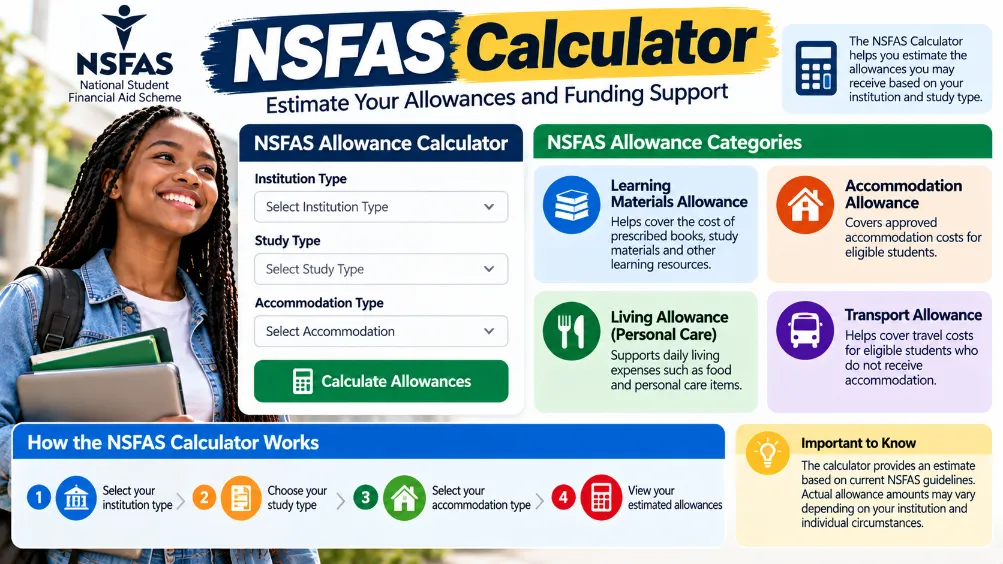
The NSFAS Calculator helps students estimate their financial position using household income and selected student details. It can show how an entered income amount compares with the main NSFAS financial thresholds.
The calculator works as an estimate, not as a final funding decision. Its main purpose is to make the income calculation easier and show the result in a simple format.
For a basic calculation, you can enter:
- Parent or guardian income
- Second parent or guardian income
- Student income
- Spouse income, where applicable
- Student category
- University or TVET option
- Study type
NSFAS Calculator
Estimate your NSFAS financial eligibility using the income and student details below.
NSFAS Calculator Household Income
Household income is one of the main figures used in an NSFAS financial assessment.
A simple calculator can add the relevant annual gross income amounts:
Parent/Guardian 1 + Parent/Guardian 2 + Student + Spouse = Household Income
Not every student needs to enter every field. The relevant income depends on the student’s personal circumstances.
| Income field | Amount |
|---|---|
| Parent/Guardian 1 | R180,000 |
| Parent/Guardian 2 | R120,000 |
| Student | R20,000 |
| Spouse | R0 |
| Total household income | R320,000 |
In this example, the calculator produces a household income of R320,000 per year.
NSFAS Calculator Monthly Income to Annual Income
Many students know their household income as a monthly amount rather than an annual amount.
The calculation is straightforward:
Monthly gross income × 12 = Annual gross income
For example:
| Monthly gross income | Annual gross income |
|---|---|
| R15,000 | R180,000 |
| R20,000 | R240,000 |
| R25,000 | R300,000 |
| R30,000 | R360,000 |
| R40,000 | R480,000 |
| R50,000 | R600,000 |
Use gross income rather than the amount received after deductions.
NSFAS Calculator Monthly Income to Annual Income
Convert monthly gross income into annual gross income using a simple calculation.
This tool only performs the monthly-to-annual income calculation. It does not determine NSFAS funding eligibility.
NSFAS Calculator Gross Income
The NSFAS Calculator should use gross income for a household-income estimate.
Gross income refers to earnings before deductions such as:
- Tax
- Pension contributions
- Medical deductions
- Other payroll deductions
For example, a salary of R25,000 per month before deductions gives an annual gross income of:
R25,000 × 12 = R300,000
The calculator should therefore use R300,000 as the annual income figure.
NSFAS Calculator R350,000 Threshold
The general NSFAS bursary financial threshold is R350,000 per year for eligible applicants who do not fall under the disability or verified SASSA categories.
A calculator can compare household income against this amount.
| Annual household income | Calculator position |
|---|---|
| R200,000 | Below R350,000 |
| R275,000 | Below R350,000 |
| R325,000 | Below R350,000 |
| R350,000 | At R350,000 |
| R375,000 | Above R350,000 |
| R450,000 | Above R350,000 |
Being below the income threshold does not by itself guarantee funding. The calculator only evaluates the financial-income portion.
NSFAS Calculator R600,000 Threshold
Students with disabilities have a higher NSFAS bursary household-income threshold of R600,000 per year.
The calculator can use this amount for the disability category.
| Annual household income | Position against R600,000 |
|---|---|
| R350,000 | Below threshold |
| R450,000 | Below threshold |
| R500,000 | Below threshold |
| R600,000 | At threshold |
| R650,000 | Above threshold |
The disability option should therefore be selected correctly before calculating the result.
NSFAS Calculator for SASSA Recipients
A calculator can provide a separate verified SASSA recipient option because SASSA status affects the financial requirement.
For a calculator, selecting the SASSA category can produce a result stating that the financial requirement is treated differently from the standard household-income calculation.
The calculator should still make clear that this is an estimate and that the final NSFAS assessment has its own rules.
NSFAS Calculator for Students With Disabilities
The disability option changes the income threshold used by the calculator.
For a basic calculator:
General applicant → R350,000 threshold
Student with disability → R600,000 threshold
Example:
| Student category | Household income | Calculator threshold |
|---|---|---|
| General applicant | R340,000 | R350,000 |
| General applicant | R390,000 | R350,000 |
| Disability category | R390,000 | R600,000 |
| Disability category | R580,000 | R600,000 |
| Disability category | R650,000 | R600,000 |
This makes the selected student category important for the calculation.
NSFAS Calculator for University Students
A university calculator can use household income as its main financial input.
For a simple university calculation:
- Enter parent or guardian income.
- Add the second parent or guardian income, where applicable.
- Add student income, where relevant.
- Add spouse income for a married student.
- Select the applicable student category.
- Calculate the total household income.
- Compare the amount with the applicable threshold.
The result can then show the household income and the threshold used.
NSFAS Calculator for TVET Students
A TVET option can be added to the calculator so users can identify their institution type.
The income calculation itself can still use the relevant household-income figures.
| Selection | Calculator purpose |
|---|---|
| Public university | University calculation |
| Public TVET college | TVET calculation |
| General applicant | R350,000 threshold |
| Disability category | R600,000 threshold |
| Verified SASSA recipient | Separate financial requirement |
The institution selection should not be treated as a promise of funding or allowance value.
NSFAS Calculator for NSFAS Loan Income
The NSFAS Calculator can also show a separate planning result for the published income range associated with NSFAS loans.
For undergraduate students, the configured range can be:
R350,000 to R600,000 household income
For example:
| Household income | Loan-range position |
|---|---|
| R300,000 | Below the configured loan range |
| R350,000 | At the lower end |
| R400,000 | Inside the range |
| R500,000 | Inside the range |
| R600,000 | At the upper end |
| R650,000 | Above the range |
This calculator result should remain separate from a bursary result because the two funding categories use different financial conditions.
NSFAS Calculator Result
A useful calculator result should show the numbers clearly instead of giving a vague message.
A result can display:
| Result field | Example |
|---|---|
| Household income | R320,000 |
| Selected category | General applicant |
| Applicable threshold | R350,000 |
| Difference | R30,000 below threshold |
| Result | Within income threshold |
For a household income of R320,000, the difference from the R350,000 threshold is:
R350,000 − R320,000 = R30,000
NSFAS Calculator Difference From Threshold
Showing the difference can make the calculator easier to use.
For example:
Household income: R280,000
Threshold: R350,000
Difference: R70,000 below the threshold
Another example:
Household income: R390,000
Threshold: R350,000
Difference: R40,000 above the threshold
This gives users a clearer numerical result than simply displaying eligible or not eligible.
NSFAS Calculator Examples
Example 1: R250,000 Household Income
A household has an annual gross income of R250,000.
| Item | Amount |
|---|---|
| Household income | R250,000 |
| General threshold | R350,000 |
| Difference | R100,000 below |
| Calculator result | Within threshold |
Example 2: R350,000 Household Income
The household earns R350,000 per year.
| Item | Amount |
|---|---|
| Household income | R350,000 |
| General threshold | R350,000 |
| Difference | R0 |
| Calculator result | At threshold |
Example 3: R450,000 Household Income
The household earns R450,000 per year.
| Item | Amount |
|---|---|
| Household income | R450,000 |
| General threshold | R350,000 |
| Difference | R100,000 above |
| Calculator result | Above general bursary threshold |
Example 4: Disability Category
A student with a disability has household income of R500,000.
| Item | Amount |
|---|---|
| Household income | R500,000 |
| Disability threshold | R600,000 |
| Difference | R100,000 below |
| Calculator result | Within disability threshold |
NSFAS Calculator With Parent Income
Parent income can form part of the household-income calculation for students who are assessed using parent or guardian financial information.
For example:
Parent 1: R220,000
Parent 2: R100,000
Student: R15,000
Total:
R220,000 + R100,000 + R15,000 = R335,000
The calculator would therefore use R335,000 as the entered household income.
NSFAS Calculator With Spouse Income
A married student’s calculation can also account for spouse income.
Example:
| Income source | Annual amount |
|---|---|
| Student | R80,000 |
| Spouse | R180,000 |
| Total | R260,000 |
The calculator uses the applicable income information supplied by the user.
NSFAS Calculator for Zero Income
A student can enter R0 for an income field that does not apply or has no income.
For example:
| Income source | Amount |
|---|---|
| Parent 1 | R150,000 |
| Parent 2 | R0 |
| Student | R0 |
| Spouse | R0 |
| Household total | R150,000 |
The calculator then compares the resulting amount with the applicable threshold.
Zero should only be entered for a field that genuinely has no applicable income.
NSFAS Calculator Common Errors
Incorrect calculator results can come from simple data-entry mistakes.
Common issues include:
- Entering monthly income as annual income
- Using net salary instead of gross salary
- Entering the same income twice
- Forgetting a relevant household income source
- Selecting the wrong student category
- Using the R350,000 threshold for a disability calculation
- Using an old threshold
- Adding deductions to income instead of using gross income
- Entering a household total manually after already entering individual incomes
A calculator should make the individual fields clear so users can avoid double counting.
NSFAS Calculator Accuracy
The calculator can provide a useful numerical estimate, but it should not present an estimate as an official funding decision.
Its main purpose is to calculate:
Income entered → Household income → Applicable threshold → Difference → Estimated financial position
The final result depends on the information entered and the rules configured in the calculator.
What is an NSFAS Calculator?
An NSFAS Calculator is a financial planning tool that calculates household income and compares it with selected NSFAS income thresholds.
How does the NSFAS Calculator calculate income?
It adds the applicable annual gross income amounts entered into the calculator, such as parent, guardian, student, or spouse income.
What income should I enter?
Use annual gross income for the applicable income fields rather than monthly take-home pay.
What is the general NSFAS income threshold?
The general bursary income threshold is R350,000 per year for the applicable applicant category.
What is the NSFAS disability income threshold?
The published disability bursary income threshold is R600,000 per year.
Can the calculator check SASSA status?
A calculator can provide a separate SASSA category and explain that verified SASSA recipients have a different financial requirement.
Can the calculator show the difference from the threshold?
Yes. A useful calculator can show the amount below or above the selected threshold.
Does the calculator guarantee NSFAS funding?
No. It provides a financial estimate based on the information entered. A calculator result should not be presented as an official funding approval.

- NSFAS Fraud Warning: How to Spot NSFAS Scams - September 28, 2026
- NSFAS Allowances Explained - September 28, 2026
- NSFAS Contact Details - September 26, 2026