
NSFAS Allowances Explained
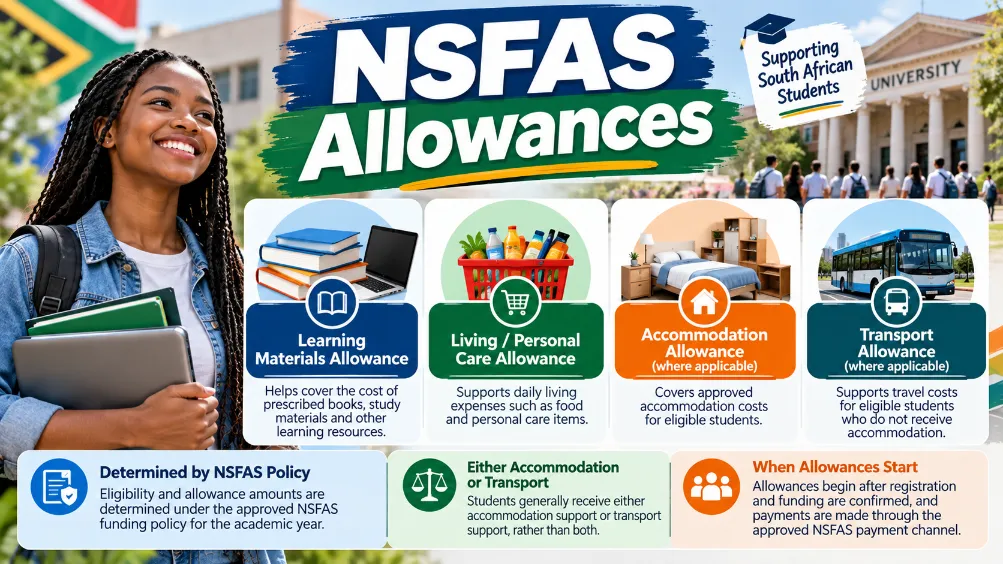
NSFAS Allowances help eligible university and TVET college students meet study-related costs beyond tuition. The funding package can cover learning materials, living expenses, accommodation or transport, depending on the student’s study arrangement and funding category. NSFAS states that students may receive either an accommodation allowance or a transport allowance, rather than both.
For the 2026 academic year, NSFAS has continued the allowance system for funded students. The scheme also made upfront payments to support eligible students at the start of the academic year. The South African government reported that NSFAS disbursed R3.6 billion to universities for allowance payments in early February 2026.
NSFAS Allowance Types
NSFAS funding can cover several student costs. The exact package depends on the student’s institution, accommodation arrangement, mode of study and funding category.
| Allowance | Main purpose |
|---|---|
| Learning materials | Books and approved study materials |
| Living allowance | Daily student living expenses |
| Accommodation | Approved student housing costs |
| Transport | Travel costs for eligible students |
| Personal care | Personal expenses under applicable funding categories |
| Assistive devices | Approved support for students with disabilities |
The 2026 NSFAS bursary guidelines state that university allowances consist of learning materials, living allowances and accommodation or transport. The funds must be used for their intended purposes.
NSFAS Learning Materials Allowance
The learning materials allowance assists students with academic resources required for their programme. The amount can depend on the applicable NSFAS rules and study arrangement.
Students who study through distance learning can have different allowance conditions. NSFAS states that distance university students taking less than 60% of the credits in an academic year qualify for the learning material allowance only.
Common study costs can cover:
- Prescribed books
- Course-related learning materials
- Other approved academic resources
- Materials required for a specific programme
The allowance should be used for education-related needs rather than general household spending.
NSFAS Living Allowance
The living allowance helps eligible students cover regular day-to-day expenses linked to studying. NSFAS lists meals and daily student expenses among the purposes covered by allowance funding.
The amount paid depends on the student’s funding category and the rules for the relevant academic year. Students should check their NSFAS funding information and institution records for the amount assigned to them.
NSFAS Accommodation Allowance
The accommodation allowance assists students who require approved housing during their studies. Accommodation arrangements can involve university residences, approved private accommodation and other housing arrangements accepted under NSFAS rules.
For 2026, NSFAS has been changing the way accommodation payments are handled. The South African government reported that private accommodation payments were being made directly to accredited providers, with signed lease agreements and valid funding information required for payment.
The latest official 2026 information also states that accommodation rates were under review. NSFAS said that final rates would be affected by factors such as inflation, student progression, enrolment levels and available budget allocations.
Important accommodation points:
- Accommodation must meet applicable NSFAS requirements.
- Private accommodation providers need to follow the relevant accreditation and payment process.
- A student cannot receive both accommodation and transport allowances under the normal allowance rules.
- Payment arrangements can differ between institutions.
- Students should check their funding and accommodation status through the official NSFAS process.
NSFAS Transport Allowance
Students who do not qualify for accommodation funding may receive a transport allowance under the applicable rules.
The 2026 NSFAS guidelines state that students qualify for either transport or accommodation funding. This prevents the same student from receiving both allowances under the standard funding structure.
Transport support can be relevant to students who travel between their residence and campus or college. The amount depends on the applicable NSFAS category and approved rates.
NSFAS Allowances for University Students
University students can receive different allowance packages based on their living and study arrangements.
A student living in approved accommodation can have accommodation funding, while a student living outside approved accommodation may fall under another allowance category. Students studying through distance learning can also have a different funding structure.
The 2026 NSFAS guidelines confirm that allowance costs are published annually and paid through an approved NSFAS payment channel.
NSFAS Allowances for TVET College Students
TVET students can also receive NSFAS allowances, subject to funding eligibility and their registered programme.
Allowance arrangements can cover:
- Learning materials
- Living expenses
- Accommodation
- Transport
- Other approved support for eligible categories
For 2026, NSFAS revised payment arrangements for TVET students. The South African government reported that TVET allowance disbursements were scheduled separately, with the first 2026 allowance disbursement revised to 13 February and a second disbursement scheduled for 27 February.
NSFAS Upfront Payment
NSFAS used an upfront payment arrangement at the start of the 2026 academic year.
The January 2026 government briefing stated that the 1 February upfront payment covered the full book allowance along with one month of meal, accommodation, personal care and travel allowances for eligible students. Universities were responsible for correct disbursement to qualifying students.
This type of payment helps institutions start allowance distribution early in the academic year.
How NSFAS Allowance Payments Work
The payment process depends on the student’s institution and funding arrangement.
The general process involves:
- The student receives confirmation of NSFAS funding.
- The institution submits valid registration information.
- NSFAS processes the applicable funding information.
- The relevant allowance is assigned according to the student’s category.
- Payment is made through the approved payment arrangement.
- The institution or approved provider handles the relevant disbursement where applicable.
TVET students receive allowances through their designated payment arrangements, while accommodation payments can be made directly to approved accommodation providers under the 2026 system.
Who Can Receive NSFAS Allowances?
A student must first qualify for NSFAS funding and be registered at an approved institution and programme under the applicable funding rules.
Allowance eligibility can depend on:
- Funding approval
- Valid registration
- Institution type
- Programme eligibility
- Accommodation status
- Distance or contact learning arrangement
- Student category
- Applicable annual NSFAS rules
Receiving an NSFAS bursary does not mean every student receives every allowance. The allowance package depends on the student’s circumstances and funding category.
Why an NSFAS Allowance May Be Delayed
Several administrative issues can affect allowance payments. NSFAS and the government have repeatedly linked payment processing to valid registration information and institutional submissions.
Common causes can include:
- Registration information has not reached NSFAS.
- Funding has not yet been confirmed.
- Accommodation information requires verification.
- Banking details require correction.
- A student has a registration or enrolment issue.
- The institution has not completed a required submission.
- Accommodation provider information requires approval.
The 2026 NSFAS briefing specifically advised institutions to submit complete and current registration information so funding administration could proceed correctly.
2026 NSFAS Allowance Rates
A major point for students is the difference between published rates from previous years and confirmed 2026 rates.
The official February 2026 government update stated that 2026 allowance and accommodation rates were under review. NSFAS said the final rates would take account of inflation, academic progression, enrolment figures and budget allocations.
This means older figures from 2024 or 2025 should not automatically be presented as the 2026 NSFAS rates.
For reference, the government published approved 2025 university allowance caps such as R5,678 for learning materials for non-disabled non-catered university students, R17,160 for living allowance and accommodation caps that varied by location and accommodation category. Those figures apply to 2025 and should not be treated as confirmed 2026 rates.
NSFAS Allowances and Accommodation Payments in 2026
Accommodation payment administration has received major attention during the 2026 funding cycle.
NSFAS reported in May 2026 that private accommodation payments for universities had been released and that more than R1.1 billion had been disbursed to accommodation providers during that quarter, benefiting more than 100,000 students.
The same statement said 95% of accommodation providers listed on NSFAS solution partner portals had verified banking details at that stage.
Students living in private accommodation should therefore check both their funding status and accommodation approval status.
How much are NSFAS allowances in 2026?
NSFAS has different allowance categories, and the amount depends on the student’s funding and study arrangement. Official 2026 information released early in the year stated that allowance and accommodation rates were under review, so old annual figures should not be presented as confirmed 2026 rates.
Does NSFAS pay for accommodation?
Yes. Accommodation forms part of the NSFAS funding package for eligible students who meet the applicable accommodation requirements. The 2026 payment dates guide system also provides for direct payments to approved private accommodation providers.
Can a student receive both transport and accommodation allowance?
Under the 2026 NSFAS funding guidelines, students may qualify for either transport or accommodation allowance, not both.
Does NSFAS pay a living allowance?
Yes. Living expenses form part of the allowance structure for eligible students. The exact amount depends on the applicable student and funding category.
Does NSFAS pay for books?
NSFAS provides a learning materials allowance under its funding rules. The applicable amount depends on the student’s study arrangement and annual NSFAS rules.
How can I check my NSFAS allowance?
Students can check their NSFAS funding status through the NSFAS Portal. Institution records can also provide information about registration and allowance processing.
Why has my NSFAS allowance not been paid?
A payment can depend on valid registration information, funding confirmation, accommodation verification, banking details and institutional submissions. Students should check their NSFAS account and contact their institution for unresolved registration or payment issues.
Are NSFAS allowance amounts the same for every student?
No. Allowance categories and amounts can vary based on factors such as institution type, accommodation arrangement, study mode and student category.

- NSFAS Fraud Warning: How to Spot NSFAS Scams - September 28, 2026
- NSFAS Allowances Explained - September 28, 2026
- NSFAS Contact Details - September 26, 2026